Head-to-Head: Macbook Pro 14 M2 2023 vs Macbook Pro 14 2024 (Detailed Comparison)
Introduction
The 14-inch MacBook Pro has become a benchmark for professionals who need a compact system without sacrificing performance. Two adjacent generations — the MacBook Pro 14 M2 (2023) and the MacBook Pro 14 (2024) — often appear on shoppers’ shortlists. The 2023 model brought Apple’s refined M2-series silicon into the compact Pro chassis, while the 2024 refresh introduced the next step in Apple’s silicon roadmap and incremental refinements to the platform.
This article compares the two machines across practical dimensions that matter to buyers: raw performance, thermals and sustained workloads, display and creative workflows, battery life, I/O and expandability, portability, and value over time. It also outlines real-world use cases — who benefits from each model — and closes with a buyer’s guide to help readers decide which laptop better fits their needs.
Quick overview: what buyers care about
- Performance per watt: Professionals need fast CPU and GPU performance without constant throttling or noisy fans.
- Sustained workloads: Video editors, 3D artists, and developers run long tasks; thermals and sustained throughput are crucial.
- Display quality: Color accuracy, HDR capability, and peak brightness matter to creatives.
- Battery life: On-the-go users want a full workday without finding an outlet.
- Ports and expandability: SD card readers, HDMI, USB-C/Thunderbolt, and charging options affect real workflows.
- Longevity and software support: Up-to-date silicon affects how long the laptop stays relevant for future macOS releases.
Detailed product review and analysis
Design and build
Both the 2023 M2-based 14-inch MacBook Pro and the 2024 model retain the sturdy aluminum unibody, the familiar wedge profile, and the same chassis dimensions favored by users who prefer a balance of screen size and portability. Apple’s focus for these two generations was not on reworking the external design but on improving internal components — so carry cases, docks, and accessories are largely interchangeable between the two.
Processors and daily performance
The 2023 14-inch MacBook Pro equipped with M2-series silicon delivers strong single-threaded performance and meaningful multi-core improvements compared with earlier generations. For tasks like compiling code, web development, and running productivity apps, the M2 model is capable and responsive. It handles heavy-duty creative apps well in typical project sizes.
The 2024 14-inch refresh moves to the next-generation Apple silicon family. The practical impact for users is higher performance in both single-threaded and multi-threaded workloads, faster GPU throughput for rendering and accelerated effects, and improvements in the neural engine used by on-device machine learning tasks. In day-to-day use — web browsing, productivity, and lightweight editing — differences might feel modest. With heavier workloads (multicam video exports, long encoding jobs, large 3D scene renders), the 2024 model completes jobs faster and sustains performance longer.
Thermals and sustained workloads
Cooling design on the 14-inch Pro prioritizes quiet operation and efficient heat dissipation. The 2023 M2 variant provides a good balance: fans remain unobtrusive for most tasks and kick in predictably under load. For extended exports or continuous builds, thermal throttling can appear but the machine still delivers higher-than-average throughput for its size.
The 2024 model benefits from silicon-level efficiency improvements and firmware tuning, so it tends to maintain higher sustained clocks for longer before throttling. For professionals who run hours-long render queues or repeated encoding passes, the 2024 model offers a noticeable improvement in end-to-end throughput and consistency.
Graphics, creative workflows and video editing
Content creators will look at GPU performance and memory bandwidth first. The M2-series options in the 2023 Pro handle color grading, VFX previews, and real-time playback of moderately complex timelines with ease. Export speeds for 4K H.264/H.265 content are competitive and acceleration via the media engine offloads much of the work.
The 2024 model enhances GPU performance and media-acceleration capabilities, which translates into faster timeline scrubbing, quicker effects rendering, and lower export times, especially with higher-resolution or RAW workflows. Photographers editing large RAW libraries will also notice faster previews and smoother batch edits when the GPU and neural engine are more capable.
Looking for the best Laptops & Computers deals on Amazon?
See Deals →Display and multimedia
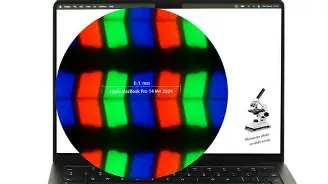
Both models use Apple’s high-contrast mini-LED displays on the 14.2-inch panel with wide color (P3) support and high peak brightness for HDR content. Color accuracy, native contrast, and support for reference-level color reproduction make both machines suitable for color-critical work.
The 2024 refresh may include refinements to display tuning and brightness control, but in practical use the difference is subtle: both deliver excellent monitoring for HDR and SDR workflows, and both are well-suited for photographers and video editors who calibrate their displays.
Battery life and real-world endurance
Battery performance depends on workload. For mixed office tasks — email, browsing, calls, and light editing — the 2023 M2 14-inch hits a full day under conservative use. With sustained editing or active GPU work, runtime drops accordingly.
The 2024 model, with its more efficient silicon, typically extends battery life in the same usage patterns and provides better runtime when doing mixed creative…
I/O and expansion
Both models keep the practical I/O set that professionals expect: at least three Thunderbolt / USB-C ports, an HDMI output, an SD card reader, MagSafe charging, and a headphone jack. This parity means photographers, videographers, and producers can plug in cameras, docks, and external displays without relying on bulky dongles.
Software ecosystem and longevity
Apple provides long-term software support for its silicon-based MacBooks. Buying the newer 2024 model provides a longer projection of OS updates and optimizations, but the 2023 M2 Pro remains well-supported and will stay useful for many years, especially for users who value current stable performance over the incremental gains of the newest chip.
Pros & Cons
MacBook Pro 14 M2 (2023)
- Pros: Mature platform with excellent performance for most professional workloads; proven thermals and quiet operation; high-quality mini-LED display; broad port selection suitable for creatives.
- Pros: Strong battery life for typical productivity and editing tasks; likely to be available at improved value relative to newer models as retailers rotate inventory.
- Cons: Less headroom for the most demanding multi-hour render tasks compared to the 2024 refresh; incremental improvements over earlier M1 Pro/Max may not justify an upgrade for all users.
- Cons: If future-proofing is a primary goal, the 2023 model has a shorter projected support window than the latest silicon.
MacBook Pro 14 (2024)
- Pros: Next-generation silicon with improved CPU/GPU performance and efficiency; better sustained performance under long workloads; marginal gains in battery life and on-device ML.
- Pros: Ideal for creatives who push timelines, encode large volumes of footage, or use GPU-accelerated effects regularly; longer projected lifecycle for software updates.
- Cons: Higher entry price at launch vs. previous generation; physical design changes are minimal, so users expecting a visual refresh may be disappointed.
- Cons: For light users or those on tight budgets, the performance uplift may not justify the premium.
Side-by-side comparison table
| Feature | MacBook Pro 14 M2 (2023) | MacBook Pro 14 (2024) |
|---|---|---|
| Typical processor | M2-series Pro/Max options — strong single-core and solid multi-core performance | Next-gen Apple silicon (M3-series family) — improved per-core throughput and efficiency |
| GPU | Multi-core GPU options suitable for most creative tasks and some heavy rendering | Faster GPU options with higher sustained throughput for complex timelines and effects |
| Unified memory | Configurable to high capacities; fast unified architecture | Similar or larger capacities with improved memory bandwidth in many configurations |
| Display | 14.2" mini-LED Liquid Retina XDR, P3 color, high contrast and HDR-capable | Same high-quality panel with possible firmware/display tuning improvements |
| Battery life (real-world) | Excellent for mixed work; reduced on heavy GPU/CPU tasks | Improved efficiency yields longer mixed-use endurance and better heavy-work runtimes |
| Ports | Thunderbolt / USB-C, HDMI, SD card reader, MagSafe, headphone jack | Same practical port selection; backward-compatible with existing docks |
| Thermals & sustained performance | Well-managed thermals; some throttling during long, heavy workloads | Better sustained clocks and efficiency for continuous workloads |
| Best for | Professionals who need powerful performance without absolute cutting-edge silicon; buyers valuing value and proven hardware | Users who run demanding creative workloads for extended periods and want the longest usable lifespan |
| Value proposition | Strong performance-to-price for many buyers; may be available at discounts | Higher upfront cost but better long-term performance and future-proofing |
Real-world use cases — which model suits which user?
Software developers and general productivity
For most developers — web, mobile, and backend — the 2023 M2 14-inch is more than capable. Full-system builds, local containerized workflows, and IDE usage run smoothly. Developers who compile very large codebases frequently or run heavy parallel CI tasks on local machines will see measurable time savings on the 2024 model, especially during repeated or prolonged builds.
Photographers and image editors
Both machines provide excellent color-accurate displays and fast day-to-day editing performance. Photographers working with very large RAW libraries or complex batch edits will appreciate the 2024 model’s improved responsiveness, though the 2023 model remains an excellent and cost-effective choice.
Looking for the best Laptops & Computers deals on Amazon?
See Deals →Video editors and motion designers
This is the area where differences matter most. If typical projects involve short edits and occasional 4K exports, the 2023 model works well. For professionals who render long timelines, work with RAW/ProRes schedules, or need accelerated previews on complex sequences, the 2024 model reduces export time and improves reliability under continuous load.
3D artists and GPU-heavy workloads
GPU performance scales in favor of the 2024 model. For real-time viewport work, GPU-accelerated simulations, and rendering, the newer silicon reduces iteration time. Users whose workflows rely heavily on GPU resources should prioritize the 2024 machine where budget allows.
Traveling professionals and students
Users prioritizing portability and battery life for long days away from outlets will find the 2024 model’s efficiency improvements noticeable. If cost or availability is the priority, the 2023 machine still offers a strong mix of portability and performance.
Buying guide: how to choose
When deciding between the MacBook Pro 14 M2 (2023) and the MacBook Pro 14 (2024), assess the following questions to align the purchase with tangible needs.
1. What are the typical workloads?
- If work consists of browsing, documents, occasional photo edits, and standard video calls, the 2023 M2 model covers these with headroom.
- If work includes multi-hour renders, sustained encoding, or heavy GPU-accelerated effects, the 2024 model delivers better throughput and shorter job times.
2. Is portability and battery life a major concern?
- Both machines are portable; choose the 2024 model for the best battery runtime under mixed and somewhat heavier tasks.
- For strictly office-style days, the 2023 model will typically meet expectations at lower cost.
3. How important is future-proofing?
- The 2024 model’s newer silicon extends the useful lifespan for software updates and emerging workflows tied to on-device ML acceleration.
- The 2023 model remains well-supported and offers a sensible balance if the budget is tighter.
4. What about budget and resale considerations?
- Expect the 2023 machine to be more aggressively priced as retailers and buyers pivot to newer stock; it often represents excellent value if a slight performance trade-off is acceptable.
- If resale value and longest useful window are high priorities, the 2024 model is the safer long-term bet.
5. Which configuration to pick?
Memory and storage choices affect longevity and real-world performance more than minor chip differences for many users. For creative professionals, prioritize additional unified memory and faster storage over the absolute top-tier CPU/GPU configuration if budget forces trade-offs. For developers and users who keep many apps and browser tabs open, more RAM improves daily responsiveness.
Practical buying tips
- Choose the highest memory tier you can reasonably afford if working with large datasets, RAW libraries, or multiple VMs/containers.
- For video professionals, invest in a storage configuration that minimizes reliance on external drives for active projects, or factor the cost of fast external SSDs into the total budget.
- Check for education, business, or seasonal discounts that can narrow the price gap between generations.
- Consider used and refurbished options for the 2023 model to maximize value while still getting a high-performing machine.
Conclusion
Both the MacBook Pro 14 M2 (2023) and the MacBook Pro 14 (2024) are compelling choices. The 2023 model offers a proven platform with strong performance, excellent display quality, and flexible I/O — an attractive option for professionals and creatives who want strong capability at a more competitive price. The 2024 model builds meaningfully on that foundation with newer silicon that improves sustained performance, battery efficiency, and GPU throughput, making it the better choice for users with heavy, continuous workloads or those who want the longest runway of software support.

Ultimately, the right pick depends on priorities: choose the 2023 M2-based 14-inch for value and proven performance, and choose the 2024 14-inch if maximum throughput, longer lifecycle, and the fastest performance per watt matter most to the user’s day-to-day projects.